|
Hamlet
by William Shakespeare
directed by R. Kevin Doyle
July 19 - August 8, 2003 |
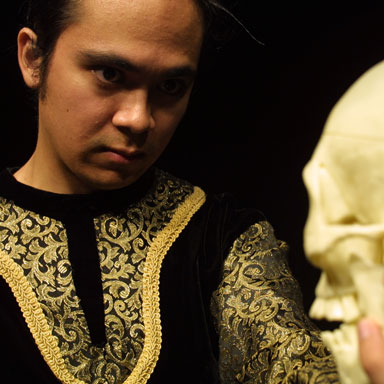
Plot Synopsis
Madness, murder and mayhem follow the melancholy
Prince
of Denmark as he seeks to avenge his father's death.
Cast
| Robb
Bonnell |
Hamlet |
| Scot
Davis |
Laertes |
|
Taurie Kinoshita |
Ophelia |
| Blake
Kushi |
Polonius |
| Shen
Sugai |
Claudius |
| Danel
Verdugo |
Gertrude |
Director's Note
In Shakespeare's life, and shortly after his
death, there were three published versions of The Tragedie of
Hamlet, Prince of Denmarke. Two were stand alone volumes
called quartos, and one was with a collection of all of
Shakespeare's plays called the First Folio.
One of the two quartos was considered to be fairly
inaccurate; sort of like a novel about a movie rushed into
printing to capitalize on the movie's success. The second quarto
is considered to be accurate to what Shakespeare wrote, as is the
version published in the First Folio.
Of course, the problem is that the second quarto and the
first folio are different in several regards. Also, there are a
couple of passages in the first quarto that, for whatever reason,
are considered more accurate than either of the other editions.
This means that scholars, in attempting to construct a
definitive edition of Hamlet need to look at all three
versions to create a copy of Hamlet that you would pick up
in a book store. One popular publisher of Shakespeare, Arden, has
even given up trying to create a definitive edition and will just
publish all three versions of Hamlet later this year.
In addition, Shakespeare (or his publishers) didn't always
use accurate spelling when they made their books. For example,
there is a famous speech of Hamlet's that begins "Oh, that this
too, too sullied flesh..." or maybe "too, too sallied flesh..."
or, perhaps, "too, too solid flesh." Thus, between the different
editions and the variant spellings, scholars can't quite agree on
whether there is a definitive version of Hamlet or not.
Over the years, scholars and directors have made a number
of assumptions about the play that have come to be thought of as
fact that are, in fact, bunk. The Arden Shakespeare folks do a
pretty good job of debunking many of these Shakespearean urban
myths.
For example, everyone knows that when Hamlet tells Ophelia
to "get thee to a nunnery," that he is really referring to a
whorehouse. Well, the folks at Arden did some research and found
that, in Shakespeare's time, when people said "nunnery," they
meant a place where nuns live. It wasn't until a hundred years
later that scholars decided it meant the other.
Ultimately, a modern director staging Hamlet needs to wade
through all of this material and figure out how to best make the
play entertain a modern audience. I believe that the best way to
do this is to follow Dr. James Brandon's method of translating
Kabuki theatre for an American audience: use the model and make it
work. My understanding of this is that a director should try to
identify how the play worked for it's original audience and then
try to make it work for the new audience in a similar way. For
this production, I used the Arden as my guide in determining how
the play worked for an audience in Shakespeare's time.
Ultimately, I hope that our production works for you. Thank you
for coming and enjoy the show.
top |
|
|
|
|
Two Gentlemen
of Verona
by William Shakespeare
directed by Tony Pisculli
July 16 - August 10,
2002 |
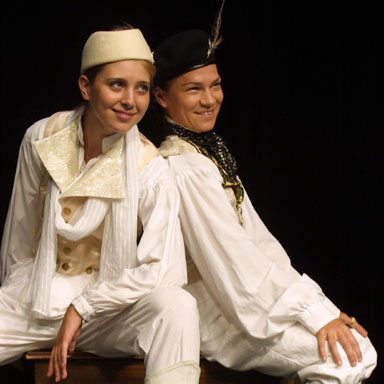
Plot Synopsis
All-female
production of this early romantic comedy. Valentine
and Proteus test the bonds of friendship when they vie for the
love of the same woman.
Cast
|
Elizabeth Wolfe |
Valentine |
|
Jennifer Robideau |
Julia |
| M.J.
Coats |
Thuria |
|
Noelle Poole |
Silvia |
|
Jennie S. Frazer |
Antonio/Host/Outlaw 2 |
|
Phoebe Johnson |
Crab
the Dog |
Director's Note
The Two Gentlemen
of Verona
is one of Shakespeare’s earliest comedies. Though often dismissed
as a mere rough-draft of Twelfth Night, it deserves to
stand on its own, not only for the central romantic story but for
the inclusion of Lance, one of the greatest clowns in all of
Shakespeare’s plays.
Some critics have expressed dismay, or even
outrage, at the play’s happy resolution after the surprisingly
dark turn of events in the final scene. In the Elizabethan age,
friendship between men was valued higher than any other
relationship, higher even than romantic love.
Without a proper context, modern audiences are apt
to come away with the idea that Valentine and Proteus are more
enraptured with each other than with Sylvia and Julia. With an
all-female cast this perception does not so readily arise.
Perversely, it is easier to stay true to the author’s original
intent by turning his conception of casting on its head (in
Shakespeare’s day all roles would have been played by men as women
were forbidden to act on the stage).
top |
|
|
|
|
Coriolanus
by William Shakespeare
directed by Harry Wong III
August 2 - August 11,
2002 |
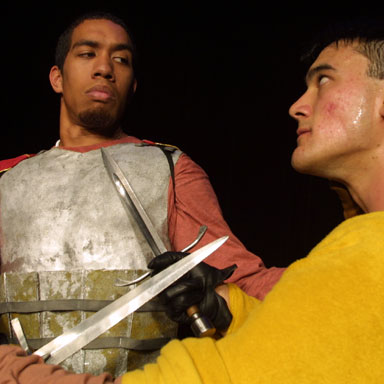
Plot Synopsis
An epic
tragedy about a general, driven by wounded pride and warlike
ambition, who vows revenge on his own city. Don't miss this rare
opportunity to see Shakespeare's last great tragedy.
Cast
|
Antonio Anagaran, Jr. |
Tullus Aufidius |
| Alvin
C. G. Chan |
Sicinius Velutus |
| Chris
Doi |
Junius Brutus |
| Moses
Goods III |
Coriolanus |
| Linda
Johnson |
Volumnia |
| Yama
Lake |
Lieutenant to Aufidius |
Director's Note
Ever
since Coriolanus was announced as part of the Festival,
people have asked me, "why?" The play has never been thought of
as one of Shakespeare’s best; I've heard it called
"Crawl-up-your-anus" because no one in the play is likeable, or in
the end noble. True, this is not one of Shakespeare’s most
popular plays, but how could it be? He shows us in our most
unforgiving role – as political animals, and none of us are
spared. We find nothing attractive about ourselves when this
mirror Coriolanus is held up to nature. That is why I like the
play; why I like any of his plays. They all contain a truth of
what we are, however wonderful, ridiculous or terrible.
More than two millennia ago, Aristotle, one of the dead
"olive-skin" men, said that persuasion in politics should only
rely on our capacity for reason, and not our emotions or the
personal charisma of our leaders. Written in the years after the
death of Elizabeth I, Coriolanus is ultimately
Shakespeare’s cry for reason.
Dramaturg's Note
Shakespeare
wrote Coriolanus sometime between 1607 and 1610, making it
one of his last tragedies, if not his very last. The play is based
on a chapter from Plutarch's Lives, and its plot and
characters are, for the most part, historically accurate. We know,
for example, that the Roman general Caius Marcius really was
awarded the name Coriolanus after he single-handedly conquered the
town of Corioli in 494 BCE. It is also believed that Shakespeare
wrote Coriolanus in response to contemporary events: in
1607, the newly-crowned James I was at odds with Parliament over
electoral procedures, and peasants in central England were rioting
over the price of grain.
Coriolanus
has never been a popular play, either with critics or audiences.
Yet there is no denying its power. It is muscular and tightly
structured, filled with tension and intrigue. The language is
aggressive and spare, giving the story a perpetual forward thrust.
This is very much a soldier's play, filled with a soldier's
poetry, and it has no patience for prettiness or self-reflection.
Coriolanus is
often condemned for having no sympathetic characters, which at
first glance seems true: the protagonist is one of the most
arrogant and uncompromising in the entire canon, and the
supporting characters are either bloodthirsty or double-crossing,
or else shrinking violets. However, the title character is ruled
by one quality that sets him apart from the rest: honesty.
Coriolanus may be a class snob, but he does not hide his bigotry.
Oddly enough, this makes him the most genuine character in the
play, more sympathetic than the suave politicians and scheming
military leaders who surround him. Entirely lacking in social
pretension, unable to understand tact or empathy, Coriolanus acts
without thinking: lashing out at those who wound his pride or
threaten his welfare. This is both a major flaw and a major asset,
for it makes Coriolanus the perfect soldier – and the worst
politician. In the course of the play, he is called upon to be
both soldier and politician, and his inability to reconcile the
two spheres leads to disaster and tragedy.
top |
|
